Today, data is one of the most valuable assets for businesses. However, this data is often scattered across PDF documents, Excel spreadsheets, or different file formats. This can make accessing information more difficult and may lead to wasted time and errors due to manual data entry.
For this reason, many organizations prefer to transfer their existing files into a centralized database, making their data more secure, faster to access, and easier to manage.
So how can information in PDF and Excel files be transferred to a database? What stages does the process involve? Let’s take a closer look.
What Is Data Conversion?
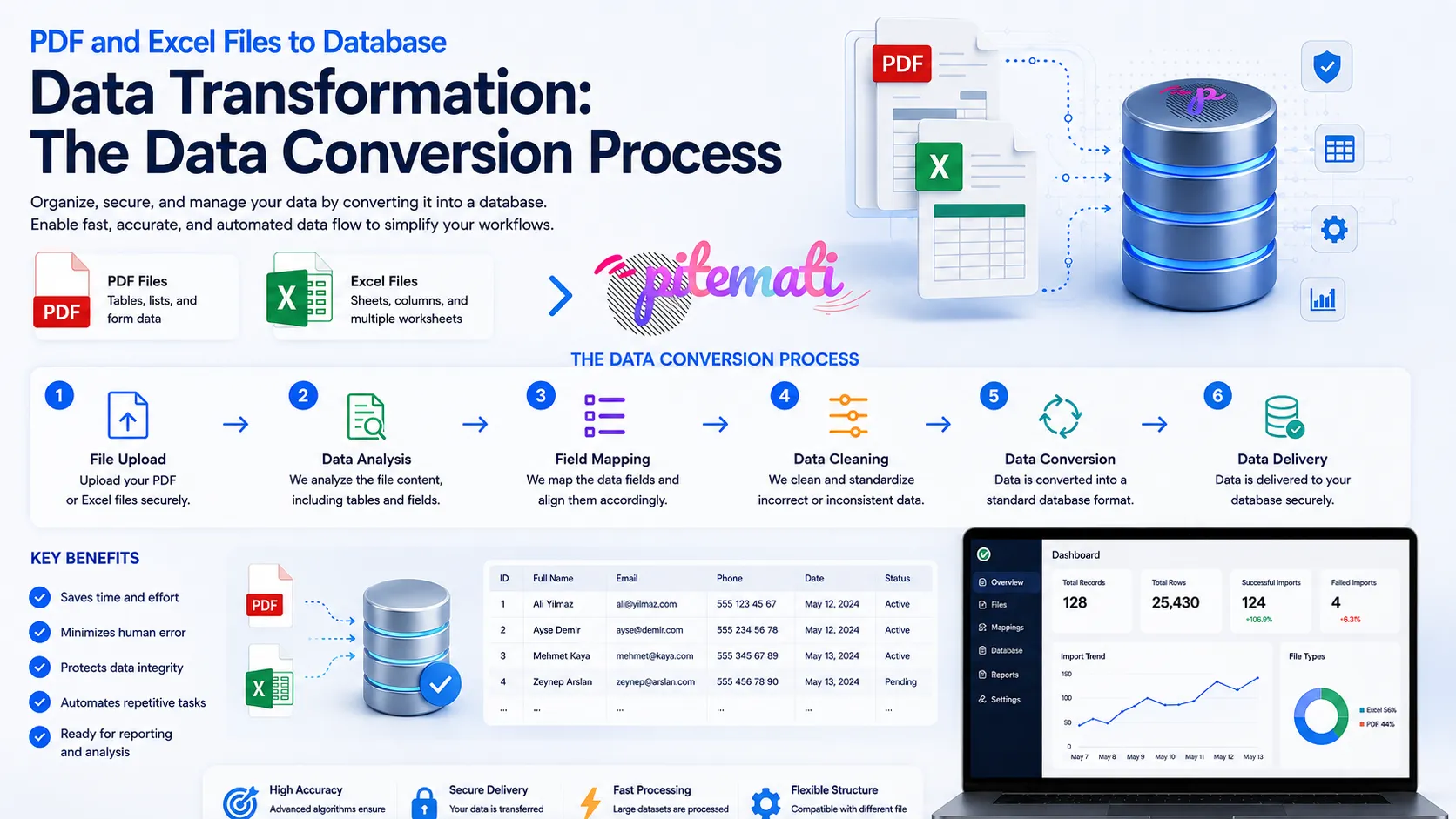
Data conversion is the process of analyzing information found in different file formats, transforming it into a standard structure, and transferring it to a database.
As a result of this process, information from different sources such as;
- PDF documents
- Excel spreadsheets
- CSV files
- XML data
- JSON files
can be collected in a single central location.
Why Is It Necessary to Transfer Data to a Database?
File-based working methods may be sufficient up to a certain point.
However, as the amount of data increases;
- searching becomes more difficult,
- preparing reports takes more time,
- duplicate records may occur,
- data integrity may be compromised,
- manual updates may increase the risk of errors.
Using a database eliminates a large part of these problems.
The First Step of the Process: Data Analysis
Not every data transfer is written directly to the database.
First, the files are analyzed.
At this stage;
- table structures,
- columns,
- data types,
- date formats,
- numeric fields,
- missing information
are identified.
Accurate analysis forms the foundation of a successful data transfer.
Field Matching (Mapping)
Every database has its own structure.
For this reason, the information inside Excel or PDF files must be matched with the appropriate fields.
For example;
| Excel Field | Database Field |
|---|---|
| Full Name | full_name |
| Phone | phone |
| Date of Birth | birth_date |
This process ensures that information is transferred to the correct columns.
Data Cleaning
In real projects, data is not always organized.
Before transfer;
- empty records,
- duplicate rows,
- incorrect characters,
- unnecessary spaces,
- incorrect date formats,
- missing information
can be identified and corrected.
This stage significantly improves data quality.
Data Transformation
The cleaned information is converted into a format suitable for the target system.
For example;
- text formats are arranged,
- date fields are standardized,
- currencies are converted,
- number formats are adapted,
- custom codes are normalized.
This allows all records to be stored according to the same standard.
Transfer to the Database
The prepared data is transferred securely to the database.
During the transfer process;
- transaction records can be kept,
- error checks can be performed,
- missing records can be reported,
- bulk operation performance can be optimized.
In large datasets, these operations can be performed automatically.
Performance in Large Data Transfers
Performance is highly important in projects where tens of thousands or even hundreds of thousands of records are processed.
In professional data transfer systems;
- batch processing,
- chunk processing,
- queue,
- background tasks,
- error logs,
- resumable operations
are used to ensure that the system works safely and reliably.
Where Is It Used?
Data conversion solutions are used in many industries.
For example;
- E-commerce product transfers
- Accounting records
- Customer databases
- Clinical patient records
- Education platforms
- Human resources systems
- Inventory management
- Corporate archive projects
- Public institutions
- Digital document management
Benefits of Automation
Compared to manual data entry, automatic data transfer;
- saves time,
- reduces human error,
- preserves data integrity,
- makes reporting easier,
- accelerates processes,
- makes large datasets more manageable.
For this reason, it is an important digital transformation step for modern businesses.
Conclusion
Transferring information from PDF and Excel files to a database is not only a data migration process; it is also an important process that enables corporate information to be managed in a more organized, secure, and sustainable way.
With a well-planned data conversion infrastructure, information from different sources can be collected in one central location, reported, and actively used in business processes. Especially for businesses working with large datasets, automatic data transfer solutions increase operational efficiency while reducing error rates and creating a more reliable working environment.