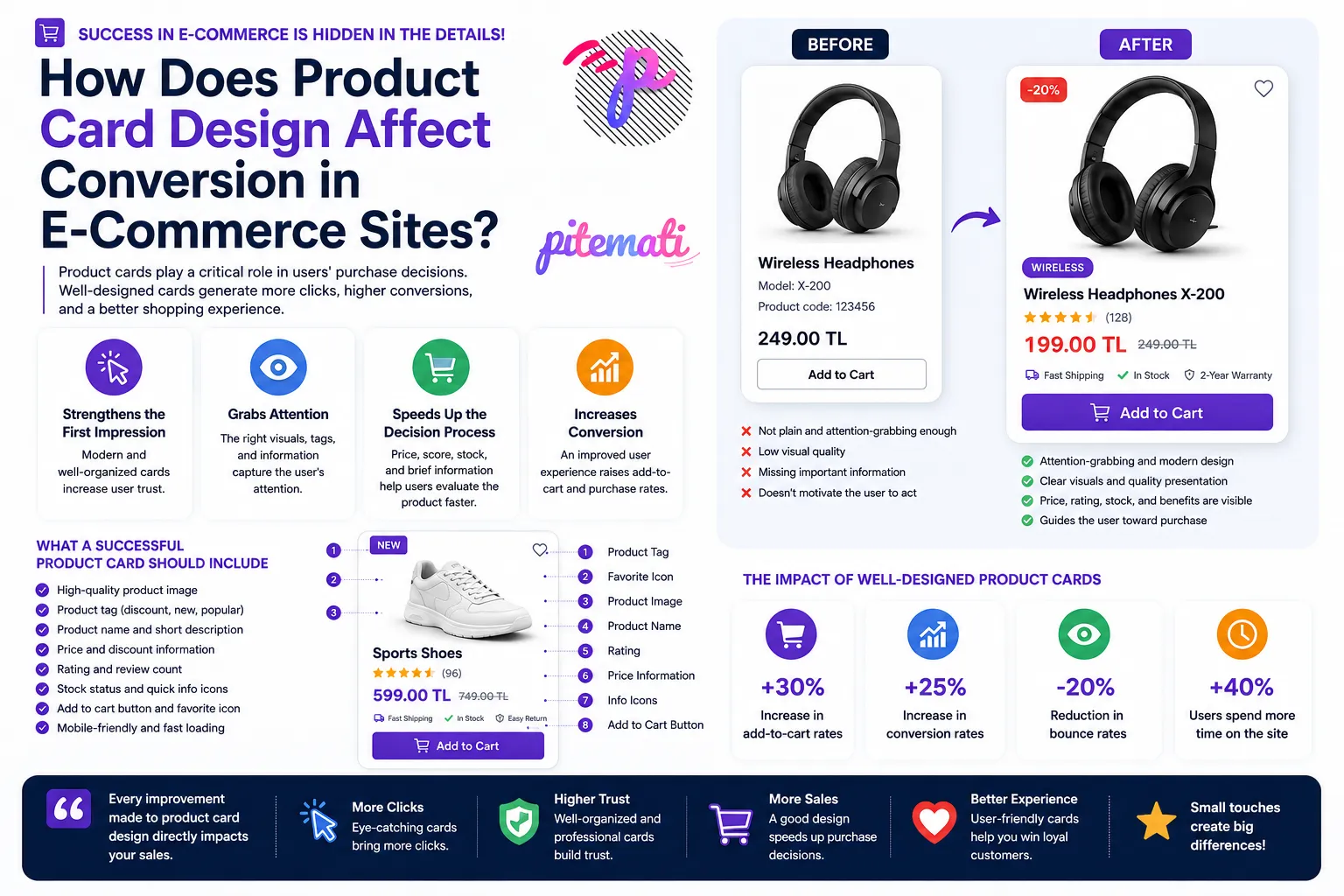
One of the first elements visitors encounter on an e-commerce website is the product card. Users often shape their decisions based on the information they see on the product card before moving on to the product detail page.
For this reason, a product card is not just an area for an image and a price. A well-designed product card can improve the user experience, build trust, and positively influence the purchasing decision.
So, what elements should a successful product card design include, and how does it affect conversion rates?
What Is a Product Card?
A product card is a component that presents visitors with the first key information about a product on product listing pages.
It usually includes the following information:
- product image,
- product name,
- price,
- discount information,
- rating,
- stock status,
- short features,
- add-to-cart button.
The layout and presentation of these areas directly affect users’ first impression of the product.
First Impressions Affect Purchasing Decisions
Internet users often evaluate a product card within just a few seconds.
During this short time, details such as;
- image quality,
- color harmony,
- readability,
- price presentation,
- visibility of buttons
help the product attract attention.
A clean and modern design can create a professional brand perception for visitors.
High-Quality Product Images
The image on the product card is often the first area users notice.
High-resolution and properly framed images can;
- make the product look more professional,
- build trust,
- increase click-through rates.
In addition, product images prepared in the same dimensions provide a more organized appearance on listing pages.
Presenting Price Information Correctly
Price is one of the most important elements that affects the purchasing decision.
On product cards, clearly displaying information such as;
- current price,
- discounted price,
- old price,
- VAT information,
- currency,
- campaign label
helps users evaluate the product more quickly.
Product Labels and Badges
Small visual labels can significantly increase user attention.
For example, badges such as;
- New
- Discount
- Popular
- Best Seller
- Limited Stock
- Free Shipping
help the product stand out.
However, instead of overusing these labels, displaying them only when they are truly meaningful provides a more effective user experience.
Add-to-Cart Button
Call-to-action buttons on the product card should be as visible as possible.
Users should be able to;
- review the product,
- add it to their favorites,
- add it to the cart easily,
- select a variation
and complete these actions in as few steps as possible.
This approach speeds up the purchasing process.
Building User Trust
Small pieces of information can make a big difference.
On a product card, elements such as;
- star rating,
- number of reviews,
- stock information,
- free shipping,
- warranty information,
- secure payment icons
can positively influence the user’s decision-making process.
Mobile Compatibility
Today, a large share of e-commerce visitors comes from mobile devices.
For this reason, the following qualities are very important for product cards:
- adapting to different screen sizes,
- remaining readable,
- allowing buttons to be used easily,
- scaling images correctly
The mobile user experience can directly affect conversion rates.
The Importance of Performance
Fast page loading is just as important as image quality.
In product cards, using;
- optimized images,
- lazy loading,
- a lightweight CSS structure,
- avoiding unnecessary JavaScript usage
can improve page performance.
Fast-loading pages contribute to both user satisfaction and SEO performance.
Continuous Improvement with A/B Testing
Every target audience may behave differently.
For this reason, elements such as;
- button colors,
- price display,
- label positions,
- image sizes,
- information order
can be analyzed with A/B testing and continuously improved.
Data-driven improvements can deliver more successful results in the long term.
Conclusion
Product cards are one of the first steps in visitors’ purchasing journey on e-commerce websites. Eye-catching images, clear price information, trust-building details, and user-friendly design can help products receive more attention and speed up the purchasing process.
A successful product card design does not only provide an aesthetic appearance. It also improves the user experience, strengthens brand perception, and becomes an important component that can positively affect conversion rates.