WordPress is one of the most widely used content management systems in the world, and thanks to thousands of themes and plugins, it offers fast solutions for different needs. However, every project is different, and over time, situations may arise where standard plugins are no longer sufficient.
This is where custom WordPress module development comes into play.
So, in which situations is developing a custom module a better choice than using ready-made plugins? In this article, we discuss the answer to this question in detail.
What Is a WordPress Module?
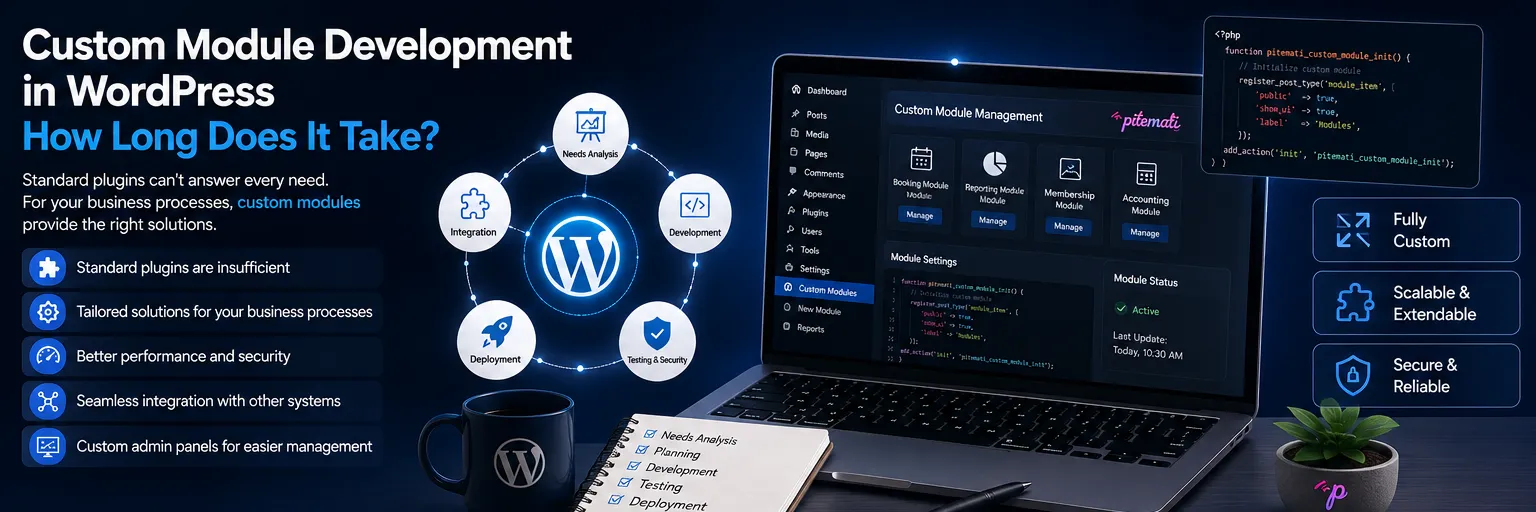
A WordPress module is a software component developed specifically for a project that adds new features to the existing WordPress infrastructure.
While ready-made plugins provide solutions for general needs, custom modules are designed only according to the requirements of a specific business or project.
For example;
- custom admin panels
- reporting systems
- reservation infrastructures
- CRM integrations
- accounting modules
- education platforms
- membership systems
- custom API connections
can be developed as custom modules.
Ready-Made Plugins May Not Always Be Enough
There are tens of thousands of plugins in the WordPress ecosystem.
However, not every plugin;
- has the same code quality,
- may be updated continuously,
- may create performance issues,
- may conflict with other plugins,
- may include unnecessary features.
Developing only the features needed for a project often provides a more efficient solution.
When Is a Custom Module Necessary?
If Your Business Processes Are Not Standard
Every company has a different way of working.
For example;
- custom quotation processes
- different approval mechanisms
- internal company operations
- custom reporting needs
may not be fully covered by ready-made plugins.
If You Need to Connect Multiple Systems
In modern web projects, different systems often need to work together.
For example;
- ERP
- CRM
- accounting software
- shipping system
- payment infrastructure
- inventory management
may require custom integrations to communicate with WordPress.
If Performance Is a Priority
In some projects, developing a single custom module instead of using dozens of plugins can be much faster and more efficient.
This approach;
- lower server load,
- faster page loading,
- easier maintenance,
- fewer conflicts
provides important advantages.
If Security Is Critical
Every added plugin may introduce a new security risk.
Custom modules that include only the required features;
- a smaller attack surface,
- a more controlled code structure,
- easier security auditing
can provide.
If You Want to Simplify Your Admin Panel
Not every user may have technical knowledge.
For this reason, with business-specific admin screens, employees only see the areas they actually need.
This makes usage easier and reduces the possibility of errors.
Advantages of Custom Modules
- Development tailored to specific needs
- A structure free from unnecessary features
- Higher performance
- Easy maintenance and updates
- Strong security infrastructure
- Long-term expandable architecture
- Easy integration with existing systems
- Full compatibility with business processes
Is a Custom Module Necessary for Every Project?
No.
For small-scale promotional websites, blogs, or basic corporate websites, ready-made plugins are often sufficient.
However, as the project grows and business processes become more diverse, custom module development begins to offer significant advantages.
For this reason, when making a decision, not only current needs but also future growth plans should be taken into consideration.
Conclusion
One of WordPress's greatest advantages is its flexible structure. Although ready-made plugins offer quick solutions for many projects, in situations where specific needs arise, project-specific custom modules provide significant contributions in terms of performance, security, and manageability.
A properly planned custom module infrastructure can meet your business's current needs