Today, websites are no longer simple promotional platforms made up of just a few pages. As businesses grow, new needs emerge; it may become necessary to add a blog, build an e-commerce infrastructure, create a reservation system, or develop custom management panels.
For this reason, modular structure is increasingly preferred in modern web projects.
So, what exactly is a modular website, and why is it more advantageous than traditional structures?
What Is a Modular Website?
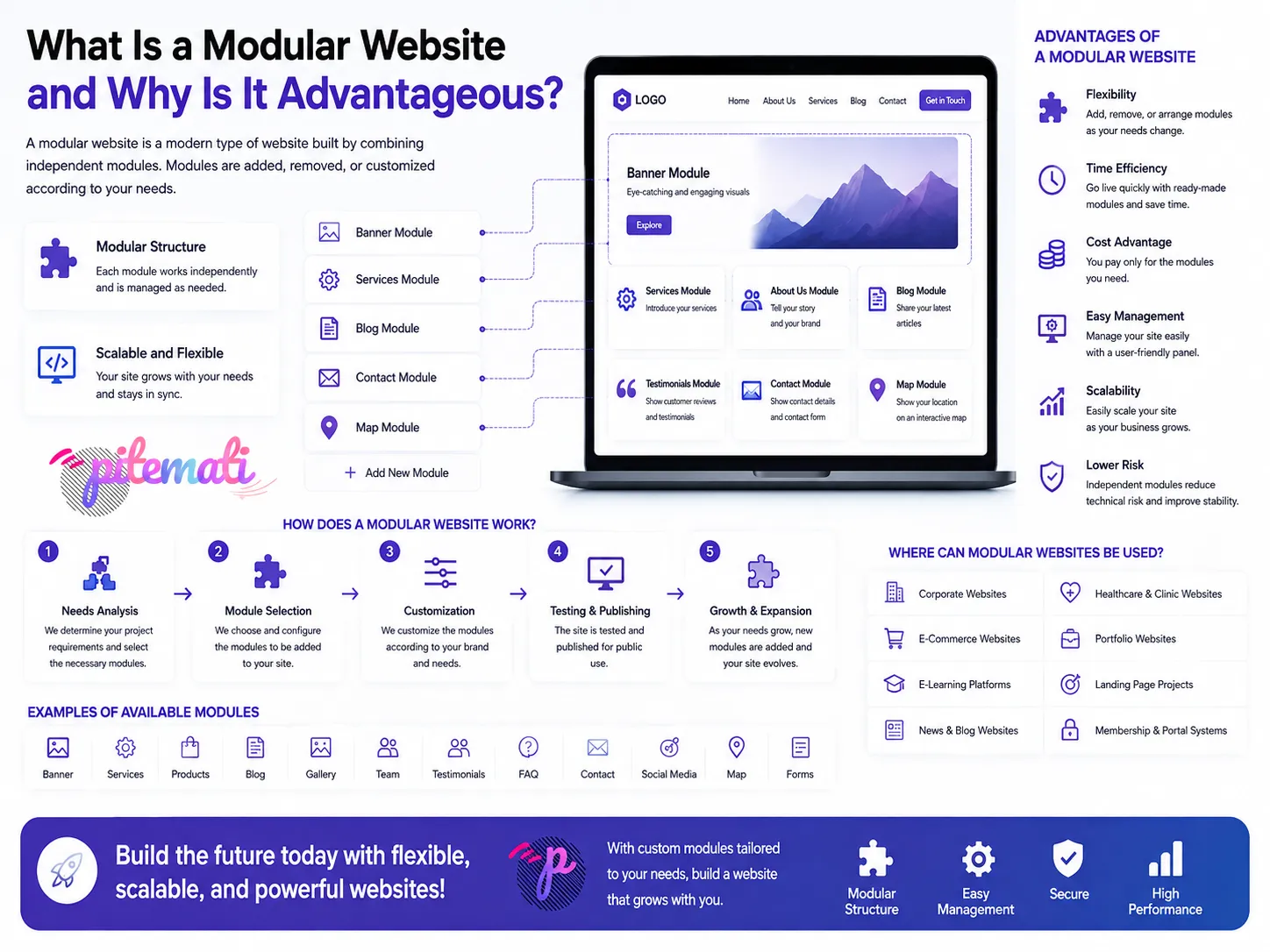
A modular website is a software architecture made up of components that work independently from one another.
Each module performs a specific task and can be developed, updated, or removed from the system when necessary, independently of other modules.
For example, on a website;
- Main Slider
- Services
- Blog
- Products
- References
- Contact Form
- Gallery
- FAQ
- Appointment System
- Membership System
each section can be designed as a separate module.
It Offers a Flexible Structure
The needs of every business may change over time.
A project that initially starts only as a corporate promotional website may later need new features such as;
- blog,
- e-commerce,
- dealer system,
- customer panel,
- online payment,
- reservation
as the project develops.
Thanks to modular architecture, these improvements can be made without completely changing the existing system.
It Simplifies the Development Process
The fact that modules work independently from one another makes the software development process more manageable.
The possibility that changes made to one module will affect other sections is reduced.
This;
- shortens development time,
- simplifies maintenance processes,
- makes error management more controlled.
It Can Be Updated More Easily
In large systems written as a single piece, even a small change can affect the entire project.
In modular structures, only the relevant module is updated.
For example, only the;
- blog system,
- product cards,
- payment module,
- user panel
can be updated.
This approach both saves time and preserves the stability of the system.
It Provides a Scalable Infrastructure
As businesses grow, their websites also need to evolve.
Thanks to a modular structure;
- new pages,
- new management screens,
- different user roles,
- new integrations,
- API connections
can be easily added to the system.
This turns the project into a flexible structure that can be used for many years.
It Provides Advantages in Terms of Performance
In well-planned modular systems, only the components that are needed are activated.
This approach;
- can reduce unnecessary code load,
- can improve page loading speed,
- can simplify maintenance processes.
This architecture offers important advantages, especially in large projects.
It Is Easier to Manage
In management panels with a modular structure, each section can be managed independently.
For example;
- slider management,
- blog management,
- product management,
- media management,
- SEO settings,
- user management
can be arranged on separate screens.
This allows administrators to focus only on the areas they need.
Reusable Components
One of the important advantages of modular systems is that they are reusable.
Components developed in one project, such as;
- contact form,
- gallery system,
- announcement module,
- references section,
- pricing table
can also be used in other projects.
While this approach speeds up the development process, it also helps provide a consistent user experience.
Which Projects Can It Be Used For?
Modular architecture can be preferred in many different types of projects.
For example;
- Corporate websites
- E-commerce platforms
- Education systems
- Clinic management software
- Accounting applications
- Digital product stores
- Membership systems
- News portals
- Dictionary projects
- SaaS platforms
modular structure provides significant advantages across different fields.
Advantages Provided by a Modular Structure
A well-planned modular website;
- can be developed more easily,
- can be updated more quickly,
- can adapt to different needs,
- can reduce maintenance costs,
- can make it easier to add new features,
- can contribute to performance optimization,
- can offer a sustainable infrastructure in the long term.
Conclusion
The modular website approach is one of the fundamental building blocks of modern software development processes. Thanks to components that work independently from one another, web projects become more flexible, more manageable, and more easily adaptable to future needs.
As businesses grow, their needs also change. A modular infrastructure makes it possible to add new features in a controlled and planned way instead of rebuilding the existing system from scratch. This approach provides important long-term advantages not only for software developers, but also for the businesses that manage the website.